
But getting there isn't always simple. Buyers routinely get tripped up by confusing terminology, unclear adhesive choices, file setup errors that wreck a spine, or the challenge of finding a printer who can actually deliver at volume without missing deadlines.
This guide breaks down what perfect binding is, walks through exactly how the process works step-by-step, and explains how to choose a service partner who won't let your project fall apart at the seams (literally).
Key Takeaways
- Perfect binding uses adhesive, not staples or stitching, to create a flat, professional spine
- PUR adhesive offers superior durability; EVA is faster and more economical for shorter runs
- Most modern binders can handle runs as thin as 32 pages, though thickness affects spine legibility
- Proper file setup (bleed, glue-trap margins, and grain direction) prevents costly production issues
- Choosing a provider with strong pre-press support and fast turnaround reduces risk and delays
What Is Perfect Binding?
Perfect binding is an adhesive-based finishing technique. Individual pages get glued directly to a spine and cover, with no staples, no stitching, no wire, just a strong bond of glue holding everything together.
The result looks like a paperback book: a flat, square spine capable of carrying printed text, title information, or a barcode. It's the format readers associate with real, professionally produced print: catalogs, manuals, magazines, and softcover books all rely on it.
A few defining characteristics separate perfect binding from other finishing methods:
- Square spine that can display printed text and branding
- Softcover format with a wrap-around cover glued to the book block
- Pages that don't lay fully flat once bound, due to the rigid adhesive spine
- Scalable page counts, with modern equipment handling shorter runs than older machines ever could
That scalability shift matters. Perfect binding once required a hefty page count to make sense, but current binding lines have pushed that threshold much lower. This opens the method up to shorter print runs that wouldn't have justified the setup a decade ago.
Perfect Binding vs. Other Binding Methods
Perfect binding isn't the only option on the table. Two alternatives come up constantly:
- Saddle stitching: Folded pages get stapled through the spine. Fast and cheap, but staples can't hold together once page counts climb.
- Spiral or coil binding: Coil threads through punched holes, letting pages lay flat and fold back completely. Great for workbooks, but it lacks a polished, bookstore look.
Perfect binding wins when a project needs a retail-ready appearance and exceeds what staples can handle. If you're producing a 200-page annual report, perfect binding is the only one of the three that makes sense.
The Perfect Binding Process: How It Works Step-by-Step
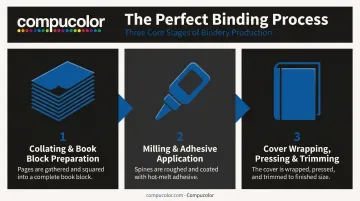
Every perfect-bound project moves through three core stages: preparing the book block, applying adhesive, and attaching the cover. Here's what actually happens at each stage.
Step 1: Collating and Preparing the Book Block
Operators gather pages in sequence, jog them flush against the spine edge, then square the stack using a precision cutter. This creates the "book block," the stack of interior pages that will eventually receive the cover.
One detail printers overlook constantly: grain direction. Paper grain should run parallel to the spine. Get this wrong, and the finished book is prone to waves, warping, or spine cracking down the road.
Step 2: Milling and Adhesive Application
Next, the binding line mills or grinds down the spine edge. This roughens the surface and exposes paper fibers, giving the adhesive something to actually grip instead of bonding to a smooth, sealed edge.
Compucolor's Mueller Martini binding line applies adhesive through nozzle systems, delivering consistent glue coverage across the entire spine width. Before committing to a full production run, operators typically run page pull-tests, physically pulling single sheets to confirm the bond will hold under real-world handling.
Step 3: Cover Wrapping, Pressing, and Trimming
The line applies the wrap-around cover directly over the freshly glued spine, then presses and cools the book to let the adhesive set. A three-knife trimmer follows, squaring up the top, bottom, and face edges.
A few layout details matter enormously here:
- Page counts must be divisible by two
- Cover design needs a glue-trap margin, extra overhang that catches excess adhesive squeezed out during pressing
- Crossover images near the spine need extra allowance, or they risk disappearing into the gutter once the book is bound
PUR vs. EVA Adhesive: Which Is Right for Your Project?
Adhesive choice is where a lot of perfect-bound projects succeed or fail. The two dominant options, EVA and PUR, behave very differently under pressure.
EVA (Ethylene Vinyl Acetate) is a conventional hot-melt glue. It sets fast as it cools, making it cost-effective and efficient for shorter-run, lighter-use pieces like event programs or one-time promotional booklets.
PUR (Polyurethane Reactive) adhesive cures through a chemical reaction with moisture in the air, not just cooling. That curing process takes longer, but it produces a bond that's significantly more durable and flexible.
| Factor | EVA | PUR |
|---|---|---|
| Set time | Fast (cooling-based) | Slower (moisture-curing) |
| Best for | Shorter runs, lighter use | Heavy handling, long shelf life |
| Solvent/ink resistance | Moderate | High |
| Flexibility | Standard | Superior, better lay-flat behavior |
| Cost | Lower | Higher |
The durability gap isn't marketing talk. According to page-pull testing reported by PostPress, PUR bonds are often up to 50% stronger than comparable EVA bonds. That gap widens on coated or heavier stocks, where digital-printed ink can interfere with a standard hot-melt bond.
Match the adhesive to the job. A one-time conference program doesn't need PUR's premium durability. A reference manual that'll get opened and closed daily for years absolutely does.
When to Choose Perfect Binding: Ideal Applications
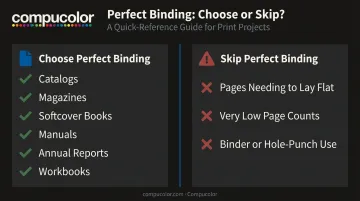
Perfect binding fits a specific range of print projects well. It's the standard choice for:
- Catalogs and product lookbooks
- Magazines and trade publications
- Softcover books
- Manuals and reference guides
- Corporate annual reports
- Workbooks and training materials
Thickness matters more than people expect. Spine text only becomes legible once the book block reaches a minimum thickness, so a 40-page piece might bind fine but won't have room for readable spine copy. Thicker projects with 80 lb text and sturdy cover stock generally produce the cleanest results.
On the low end, modern equipment has expanded what's feasible. PostPress reports that current binders can handle perfect binding at 32 pages or fewer, though that's an equipment capability, not a guarantee. Paper thickness still determines whether the spine holds a usable shape.
Compucolor's Mueller Martini bindery equipment handles this full page-count range, from slim workbooks to thick catalogs. Even so, some projects call for a different binding approach entirely.
Skip perfect binding when:
- Pages need to lay completely flat (choose coil or spiral instead)
- Page count is very low and doesn't justify the process
- The piece will be hole-punched or placed in a binder
Pre-Press Design Tips for Flawless Perfect Binding
Most perfect-binding failures trace back to file setup, not the binding equipment itself. A few things to nail down before sending files to print:
Spine width calculation. Spine width depends on page count and paper thickness (measured in PPI, pages per inch). Because that number shifts depending on stock, cover design should wait until paper stock is finalized. Guessing early almost always means a redesign later.
Bleed and safety margins. Cover bleed typically needs to extend an eighth of an inch beyond the trim edge, with text and images kept at least half an inch from the spine itself.
Crossover images that run across two pages need extra clearance. Roughly an eighth of an inch (or more) can vanish into the gutter once the book is bound and doesn't lay flat.
Glue-trap and knockout zones. This is the detail that trips up first-time designers most often:
- Keep ink and coatings out of the adhesion area on the spine and cover interior
- Coatings prevent proper glue bonding, leading to pages that pull free after binding
- Build in a dedicated knockout zone around the spine before applying any varnish or laminate
Getting these three details right before files go to print saves rework, reprints, and missed deadlines. A prepress review with your printer, such as Compucolor's in-house design team, can catch these issues before the job hits press.
How to Choose the Right Perfect Binding Service Provider
Not every printer runs perfect binding well. A few criteria separate a reliable partner from a risky one:
- Turnaround speed relative to your deadline and order volume
- Quality control, including pull-testing and spine inspection before a job ships
- Equipment sophistication, since automated nozzle-glue systems produce more consistent bonds than older manual lines
- File submission process, ideally online with clear spine templates provided upfront
An experienced pre-press team is worth more than most buyers realize. Catching a miscalculated spine width or a missing glue-trap margin before printing saves both money and time, compared to discovering the problem after 5,000 copies come off the line.
Sustainability credentials increasingly matter, too. Brands are paying closer attention to where their print materials come from. Certifications like the Sustainable Forestry Initiative require documented chain-of-custody tracking through every stage of production, from sourcing through the finished, labeled product.
Where Compucolor Meets These Standards
Headquartered in New York City, Compucolor runs a national production facility built to handle both short perfect-binding runs and large-volume jobs. Turnaround typically lands in the 24 to 72-hour range.
The company is sustainably certified and holds Sustainable Forestry Initiative membership, giving buyers a documented sustainability trail instead of a vague claim.
Compucolor also keeps design, printing, binding, and direct mail distribution under one roof. That matters for anyone who's dealt with the delays of shuttling a project between three separate vendors, waiting on files to transfer, specs to get re-explained, and deadlines to slip.
Frequently Asked Questions
What is perfect binding?
Perfect binding is an adhesive-based method of attaching pages and a cover to a spine without staples or stitching. It's the standard finishing technique for catalogs, softcover books, and manuals.
What is the difference between PUR and EVA glue in book binding?
PUR offers superior flexibility, durability, and resistance to ink and solvents, making it ideal for heavy-use pieces. EVA sets faster and costs less, working well for shorter-term, lighter-handling projects.
What is the minimum page count for perfect binding?
Most modern binders can handle runs as thin as 32 pages, though a thicker book block is needed for a secure bond. Legible spine text typically requires additional thickness beyond that minimum.
Can a perfect bound book lay completely flat?
No. The rigid adhesive spine prevents pages from opening fully flat. If hands-free, flat-opening use is essential, coil or spiral binding is a better fit.
Is perfect binding more expensive than saddle stitching?
Yes, since adhesive application and trimming add production steps that stapling doesn't require. In exchange, you get a higher page-count capacity and a more premium, retail-ready finish.
How long does perfect binding turnaround typically take?
Turnaround depends on quantity, adhesive type, and finishing complexity. Compucolor offers 24 to 72-hour turnaround on most perfect-binding orders.