That reflective, tactile shine is foil stamping at work. It's a finishing technique that marketing professionals, event planners, and businesses reach for when standard ink just won't cut it for business cards, direct mail, invitations, and other print materials that need to make a real first impression.
This article breaks down what foil stamping actually is, how the process works, the different types available, what it costs, and how to pick the right technique for your next project.
Key Takeaways
- Foil stamping uses heat, pressure, and a metal die to bond foil onto paper, leather, or fabric
- Hot foil suits fine detail, cold foil speeds large runs, and digital foil enables no-die personalization
- Costs depend on die setup, foil coverage, run size, and substrate, while digital foil skips tooling fees
- Compucolor pairs foil accents with variable data printing to make direct mail stand out
What Is Foil Stamping?
Foil stamping is a print-finishing method that transfers a thin layer of metallic or pigmented foil onto a surface using heat, pressure, and a custom-engraved metal die. The die presses the foil against the material, bonding the design permanently while lifting away the excess foil around it.
Standard ink sits flat on the page. Foil, on the other hand, creates a raised, reflective surface that catches light and changes appearance depending on the angle you're viewing it from. That's a visual and tactile effect ink simply cannot replicate.
Why It Matters for Brand Perception
A 2024 FSEA-sponsored study tested roughly 7,500 postcards for a national car-wash brand, comparing standard 4-color print against pieces enhanced with raised digital metallic decoration and tactile coatings.
The results were clear:
- Enhanced cards pulled a 16.8% response rate
- Print-only versions pulled 12.8%
- That gap works out to a 31.25% lift in response, according to Ritter's Printing's direct mail study
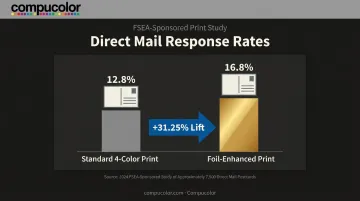
That study combined several embellishment effects, so it doesn't prove foil alone drove the result. Still, it's a useful signal: metallic, tactile print pieces get noticed and get responses in ways flat print often doesn't.
Common Materials and Applications
Foil stamping isn't limited to one type of paper. It works across a range of substrates, which is part of why it shows up in so many different marketing contexts.
Common substrates include:
- Cardstock and coated paper
- Uncoated paper (with some extra process care)
- Leather and leather-look materials
- Vinyl and synthetic stocks
Typical marketing applications:
- Business cards with metallic logos or accents
- Brochures and presentation folders
- Direct mail postcards and mailers
- Wedding and event invitations
- Point-of-purchase displays
Beyond these formats, Compucolor's creative and print teams frequently add foil accents to marketing collateral and direct mail campaigns. It's one way brands stand out, whether that's in a stack of mail on someone's kitchen counter or on a conference table during a pitch meeting.
How Does Foil Stamping Work? A Step-by-Step Process
Foil stamping looks simple on the finished piece, but there's a precise sequence behind it.
Design preparation. Artwork must be vector-based, and designers mark foil areas on a separate layer so the printer knows exactly where the foil should land.
Die creation. A die maker engraves the design onto a metal die and mounts it on the stamping press. Magnesium dies work well for smaller areas and smoother paper, while copper handles larger coverage and textured stock better.
Foil selection. Foil isn't just one material. It comes in layers:
- Carrier film
- Release coat
- Color or metallic layer
- Heat-activated adhesive
Choosing the right combination depends on the substrate and desired finish.
Heat and pressure. The heated die presses the foil against the material. Operators dial in temperature, pressure, and contact time correctly, bonding the foil to the surface while lifting away the excess.
Finishing and quality control. Finishers often pair foil with embossing or protective coatings, then inspect for clean edges and consistent transfer.
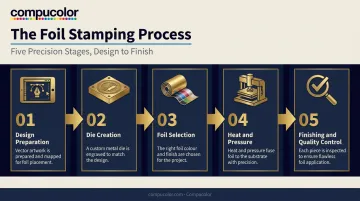
Precision matters at every step, from die engraving to final inspection. Compucolor's Komori LS 40 10-color press with H-UV coater supports this level of detail, applying foil and coating effects consistently at scale for clients nationwide.
Hot Foil Stamping vs. Cold Foil vs. Digital Foil Stamping
Not all foil stamping methods work the same way. Choosing the right one depends on your run size, timeline, and how much detail your design needs.
Hot Foil Stamping
This is the traditional method: a heated metal die presses foil onto the substrate. It delivers sharp, durable, high-detail results, making it the top choice for logos, small text, and premium packaging or stationery. It works on both coated and uncoated paper, but it does require die tooling, which adds setup time.
Cold Foil Printing (No Heat Required)
Yes, foil stamping can be done without heat. Cold foil printing applies a UV-curable adhesive to the substrate, laminates the foil on top, then cures the adhesive with UV light before removing the excess carrier. According to API Transfer Technologies, this adhesive-and-UV process replaces the heat-and-die step entirely.
Cold foil enables faster, inline production, well-suited to larger runs and heat-sensitive materials. It's also overprintable, meaning other design elements can be layered on top after the foil is applied.
Digital Foil Stamping
Digital foil skips the die completely. That makes it ideal for short runs and variable data personalization—think names, unique codes, or custom messaging on individual pieces. Compucolor's variable data printing capabilities support this same personalization, powering direct mail and marketing campaigns at scale.
Quick Decision Guide
| Method | Best For | Run Size |
|---|---|---|
| Hot foil | Intricate detail, luxury finish | Medium to large |
| Cold foil | Speed, heat-sensitive stock | Medium to large |
| Digital foil | Personalization, quick turnaround | Short to medium |
According to the FSEA/PaperSpecs Foil Cheat Sheet, hot and cold foil are generally reserved for medium-to-large production runs, while digital foil fits better with shorter runs where quick turnaround matters more than volume.
Types of Foils and Finishes
Once you've picked a method, the next decision is which foil finish fits the brand and occasion.
- Metallic foils (gold, silver, copper, rose gold): the classic choice for a luxury, timeless look
- Pigment and matte foils: solid, bold color without the shine, great for modern minimalist branding
- Holographic foils: shifting rainbow effects, popular for seasonal campaigns and specialty packaging
- Pearlescent foils: a soft, semi-transparent shimmer that works well for weddings and delicate branding
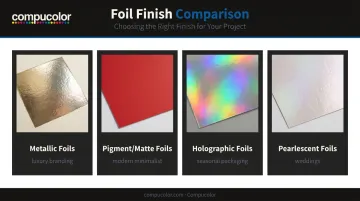
Texture often adds to the effect, though it isn't a standalone foil category. Manufacturers typically create it through the die pattern or a relief process combined with one of the finishes above.
Benefits of Foil Stamping for Marketing Materials
Foil stamping earns its place in a marketing budget for a few concrete reasons.
- Elevates perceived value. A metallic accent signals quality before anyone reads a word of copy
- Adds durability for certain grades. Manufacturer testing on matte and pigmented hot-stamping foils shows strong abrasion and scratch resistance, though results vary by foil grade
- Works across formats. From business cards to point-of-purchase displays to invitations, the same technique scales across Compucolor's full range of print materials
- Supports sustainability goals. Compucolor's Sustainable Forestry Initiative membership and environmentally responsible production practices mean premium finishing doesn't have to come at the expense of responsible sourcing
Foil functions as a signal, shaping how recipients perceive a piece before they've processed a single sentence of the message.
How Much Does Foil Stamping Cost?
Foil stamping pricing isn't one-size-fits-all. Several factors shift the final number.
Key cost drivers:
- Die/tooling charges: hot foil requires a custom die, while cold and digital foil reduce or eliminate this cost
- Foil color and coverage area: larger, more complex designs use more foil and take more press time
- Run size: larger orders typically bring the per-unit cost down for hot and cold foil
- Substrate: textured or uncoated stock may require additional process care
- Finishing add-ons: combining foil with embossing adds a step and a cost
Digital foil stamping tends to lower costs for short runs since it eliminates die setup entirely. Hot foil, meanwhile, becomes more cost-effective at scale once that tooling investment is spread across a larger order.
Rather than guessing at a budget, getting an itemized quote upfront removes the surprises. Compucolor's online submission process makes that step simple, giving businesses a clear number to plan around before committing to a run.
Frequently Asked Questions
What is foil stamping?
Foil stamping is a finishing technique that uses heat, pressure, and a metal die to transfer decorative metallic or pigmented foil onto print materials. It creates a reflective, tactile finish that standard ink can't achieve.
How much does foil stamping cost?
Cost depends on die setup, run size, foil coverage, and which technique you use (hot, cold, or digital). Since these variables shift from project to project, requesting a quote is the best way to get accurate pricing.
Can you foil stamp without heat?
Yes. Cold foil printing uses a UV-curable adhesive instead of heat, making it especially useful for heat-sensitive substrates and faster, larger production runs.
What's the difference between foil stamping and embossing?
Foil stamping adds a metallic or colored finish to the surface, while embossing raises or lowers the material without adding any foil or ink. The two are frequently combined for a layered, dimensional effect.
What materials can be foil stamped?
Common substrates include cardstock, coated and uncoated paper, leather, and fabric. These show up most often in business cards, invitations, and direct mail pieces.
How long does a foil stamping project typically take?
Turnaround depends on die creation time and run size, with hot foil generally taking longer to set up than digital methods. Compucolor offers fast turnaround on many print projects, often within 24 to 72 hours.