Introduction
Pick up a magazine, flip through a glossy brochure, or check your mailbox for a direct mail postcard. Chances are, you're holding a product of offset printing.
It's the technology behind most of the polished print materials businesses rely on every day. Yet many marketers still confuse offset with digital printing, and picking the wrong one can throw off your budget, your timeline, or the finished quality.
This guide breaks down what offset printing actually is, how the process works step-by-step, the main types you'll encounter, and how it stacks up against digital printing. By the end, you'll know exactly which method fits your next project.
Key Takeaways
- Offset printing uses a metal plate, rubber blanket, and CMYK inks to print onto paper
- It's the go-to choice for high-volume jobs like magazines, catalogs, and direct mail
- Setup costs more upfront, but per-unit costs drop sharply at scale
- Digital printing wins for small runs and personalized pieces; offset wins at volume
- The right printer offers both, so you're not stuck choosing one for every job
What Is Offset Printing?
Offset printing is a lithographic technique where an inked image transfers, or "offsets," from a metal plate onto a rubber blanket before it ever touches paper. Instead of printing directly onto the substrate, the press uses this intermediate step to produce sharper, more consistent results.
The science behind it is simple: oil and water don't mix. Plates are treated so image areas attract ink while non-image areas hold water and repel it. That separation is what lets the plate carry ink exactly where the design calls for it, nowhere else.
The CMYK Color Process
Offset printing typically runs on the CMYK model, cyan, magenta, yellow, and black, with a separate plate created for each color. This four-plate separation is the standard method for reproducing full-color artwork on press.
Because each color gets its own precisely calibrated plate, offset delivers the kind of color consistency that's hard to match at scale, which is exactly why it's remained the industry benchmark for:
- Magazines and newspapers
- High-volume brochures and catalogs
- Product packaging
- Direct mail campaigns
A Bit of History
The process traces back to Ira Washington Rubel, who built the first rotary offset press around 1903, with the model operating in his New York plant by 1904, according to the Smithsonian's National Museum of American History. Rubel reportedly stumbled onto the technique after a sheet failed to feed properly, and the resulting transfer looked cleaner than a direct impression.
More than a century later, that accidental discovery still underpins how businesses produce direct mail packages, point-of-purchase displays, and custom marketing materials at scale.
How Does Offset Printing Work? A Step-by-Step Breakdown
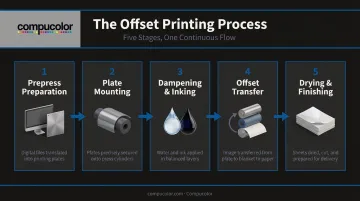
Offset printing involves several coordinated stages, each one built to protect color accuracy and consistency across thousands of copies.
- Prepress preparation. Prepress teams digitally separate designs into CMYK color layers, then burn them onto aluminum plates using computer-to-plate (CTP) technology. This skips the old film-based imaging step entirely.
- Plate mounting. Each color plate, one for cyan, one for magenta, and so on, gets mounted onto its own rotating plate cylinder on the press.
- Dampening and inking. Water rollers coat the plate's non-image areas while ink rollers coat the image areas. The oil-water principle keeps them from bleeding into each other.
- The offset transfer. This step gives the process its name. The inked image transfers from the plate cylinder to a rubber blanket cylinder, then onto the paper via the impression cylinder. Only the blanket ever touches the paper directly.
- Drying and finishing. Printed sheets pass through drying systems, either heat-set or cold-set depending on press type, before moving to trimming, folding, or binding.
Where Specialty Finishes Come In
Modern presses with in-line coating capabilities can apply specialty finishes, such as UV or H-UV coating, directly during the print run rather than as a separate step afterward.
Compucolor's Komori LS 40 press uses H-UV curing technology, pairing a UV lamp with high-sensitivity ink to cure sheets almost instantly. That means faster turnaround and a more polished final look, without sending the job out for a secondary coating pass.
Types of Offset Printing
Not every offset job runs the same way. The right setup depends on run length, substrate, and how fast you need the finished product.
Sheet-Fed Offset Printing
Individual sheets of paper feed through the press one at a time, typically handling runs from a few hundred to several thousand copies. This makes sheet-fed ideal for:
- Brochures and sales sheets
- Letterhead and stationery
- Point-of-purchase displays
It's the better fit when your job needs precision on a shorter run rather than sheer speed. Compucolor runs a Komori LS 40 10-color perfector with H-UV coating for exactly this type of work.
Web Offset Printing
Instead of individual sheets, continuous rolls, or "webs," of paper run through the press at high speed. This is the preferred method for very high-volume jobs, including:
- Newspapers
- Magazines
- Catalogs
Web offset moves faster and handles bigger volumes, while sheet-fed offers more flexibility for shorter, specialized runs.
Waterless & Quick-Set Ink Offset
Waterless offset removes the dampening step entirely by using an ink-resistant silicone layer on the plate. Quick-set inks, meanwhile, dry faster between press stages for jobs on tighter deadlines. Neither is as common as sheet-fed or web offset, but both exist for specific substrate or turnaround needs.
Offset Printing vs. Digital Printing: Which Is Right for Your Project?
This is usually where the decision actually gets made. Here's how the two methods compare across the factors that matter most.
| Factor | Offset Printing | Digital Printing |
|---|---|---|
| Setup cost | Higher (plates, calibration) | Minimal |
| Per-unit cost | Drops significantly at volume | Stays flat regardless of quantity |
| Turnaround | Slower to start, faster once running | Faster for small jobs |
| Customization | Identical copies per run | Supports variable data (personalization) |
| Best for | Large, consistent-design runs | Small runs, personalized pieces |
Cost and the Crossover Point
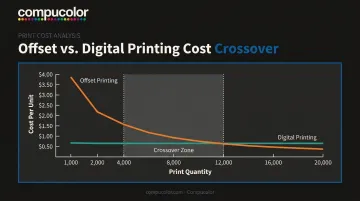
Offset carries higher upfront costs because of plate-making and press calibration. But once that setup is done, the per-unit cost falls fast, which is why long runs almost always favor offset.
Where's the tipping point? It depends heavily on your equipment and job specifics. Ricoh's analysis of cost crossover scenarios found the breakeven point ranging from around 4,000 impressions on newer, efficient presses to 12,000 or more on older equipment with longer makeready times.
There's no single magic number, but as a rule of thumb, runs in the low thousands and up start tilting toward offset.
Quality and Personalization
Offset remains the standard for color consistency across large runs, though modern digital presses have closed much of that gap for shorter jobs.
The bigger differentiator is personalization. Digital printing supports variable data printing (VDP), which the USPS defines as producing tailored mailpieces, each with different copy, imagery, or offers, printed side-by-side in the same run.
Traditional offset can't do that; every copy off the plate looks the same. For a targeted direct mail campaign where each recipient sees a different offer, digital is the only real option.
A Simple Decision Guideline
- Offset works best for large-volume, consistent-design projects: magazines, catalogs, mass mailers
- Digital wins for smaller runs, quick turnarounds, or personalized pieces
- A full-service printer, like Compucolor with its Komori offset press and HP Indigo digital equipment, keeps you from being locked into one method for every job
Why Businesses Choose Compucolor for Offset Printing
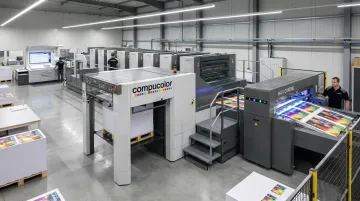
Compucolor runs offset production on a Komori LS 40 10-color press equipped with an H-UV coater, giving national clients sharper color reproduction and specialty finishes without a separate coating pass. That combination matters most on jobs where color accuracy has to hold steady across every single copy.
Speed matters just as much as quality. Compucolor typically has orders ready within 24 to 72 hours, paired with an online file submission process that skips the back-and-forth of traditional print ordering. High-volume offset work doesn't have to mean waiting weeks.
Compucolor builds sustainability into the process, too. Compucolor holds Sustainable Forestry Initiative membership and maintains responsible sourcing practices, meaning large print runs can be sourced responsibly rather than treated as an afterthought.
That same commitment to doing things right carries over to choosing the printing method itself. For businesses weighing offset against digital, having a partner that runs both technologies in-house means the printing method gets chosen based on the job, not the other way around.
Frequently Asked Questions
What is offset printing?
Offset printing is a technique that transfers ink from a metal plate to a rubber blanket, then onto paper. It's commonly used for high-volume, high-quality print jobs like magazines and catalogs.
What is the difference between offset printing and digital printing?
Offset uses plates and a blanket cylinder for indirect ink transfer, requiring setup time before printing starts. Digital printing sends the image directly from a file to the substrate, with no plates involved.
Is offset printing cheaper than digital printing?
Offset becomes cheaper per unit at high volumes since setup costs get spread across more copies. Digital is more economical for smaller quantities where plate-making wouldn't pay off.
Is offset printing high quality?
Yes. Offset is known for excellent color accuracy and sharp detail, with that consistency holding up across large runs. It's a preferred choice for professional print materials.
What is offset printing best used for?
It's ideal for large-run projects like brochures, magazines, direct mail, and packaging, where consistent quality across thousands of copies matters most.
Is offset printing environmentally friendly?
It can be, when paired with certified paper sourcing and responsible production practices. Certifications validate sourcing and chain of custody, not the printing method itself.